Philip Burke
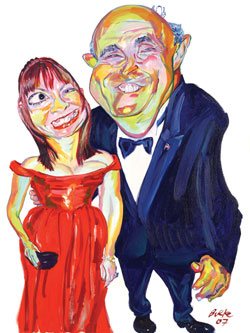
Rudy-lot! As former Mayor Giuliani’s campaign surges, his sweaty adversaries have begun to imagine the real thing.
It’s the middle of October and Rudy Giuliani is still leading the race for the Republican nomination. His old enemies in New York can’t understand it.
“It’s totally unbelievable,” said Charles Rangel, the dean of the New York Congressional delegation and a longtime adversary of Mr. Giuliani. “I refuse to believe that this could possibly happen to our country. I have too much confidence in our country to believe that this could really happen.”
All presidential candidates have some element of hometown opposition—constituents angry about a factory closing, politicians spiteful about losing a bill or an election. But no candidate engenders as much local animus as Mr. Giuliani, whose terms as mayor were characterized by a series of spectacular running battles with various, mostly liberal constituencies.
For the first months of his candidacy for president, prominent progressives in New York mocked the notion that a pro-choice, immigration-friendly serial husband with a history of opposition to guns would have a shot at the Republican nomination.
But now, with Mr. Giuliani up nearly 10 percentage points in national polls and unexpectedly competitive in the early primary states of New Hampshire and South Carolina, a mixture of nervousness and disbelief is running through the ranks of his old antagonists.
“People say, ‘Still?’” said Mark Green, a former New York City public advocate and persistent foil to Mr. Giuliani. “If the other 49 [states] knew what we knew, he wouldn’t be in the ballpark, much less winning the game.”
Norman Siegel, who served as the director of the New York Civil Liberties Union during Mr. Giuliani’s tenure as mayor, said, “I’ve been saying to people in New York, especially the liberal community that I’m proud to be part of, that unless the truth is revealed about the real Rudy, he could win, and not just the Republican nomination, but the presidency as well. Most people in New York look at me, and they say ‘no way.’ They say it can’t happen. The political leadership in New York is underestimating him. They are really in political denial. I say to people, ‘You better wake up.’”
Mr. Siegel, for one, intends to do whatever he can to forestall a Giuliani victory.
He has been encouraging the family members of Sept. 11 victims to air their grievances about Mr. Giuliani in town-hall–style settings in primary states, such as New Hampshire, where Mr. Siegel is currently trying to get Dartmouth College to give him access to an auditorium. (“There is a possibility that some of the family members might get on the road,” he said.)
Mr. Siegel says that he has also reached out to firefighter groups in South Carolina, New Hampshire and Florida in search of Giuliani critics, and he has advised his liberal brethren in New York not to endorse another candidate so as not to compromise the credibility of their anti-Giuliani testimony.
“New Yorkers who really don’t want Rudy Giuliani to be president of our country need to be talking about it, need to be writing about it, and not just in Manhattan, but to get around America,” said Mr. Siegel.
Other Giuliani nemeses have been contributing to the effort in different ways.
“I’ve not only written a book called Giuliani: Nasty Man, I’m on television programs, answering questions,” said former Mayor Ed Koch, a Democrat who has often endorsed Republicans not named Giuliani. “I have access to getting my voice heard.”
Referring to Mr. Giuliani’s performance on and after Sept. 11, he added, “We can’t equate his eight years of outrageous behavior with his several weeks of superb behavior.”
Mr. Giuliani’s detractors lament that his strong showing is a freakish anomaly caused by the overall weakness of the Republican field.
“It’s just that there is no one really for him to do badly against,” said Mr. Rangel, managing to sound amazed. “He is competing with a worn-out television actor. It’s tragic.”
Mr. Rangel said that he was nevertheless confident that Mr. Giuliani’s fortunes would eventually decline, whether because of the incongruity of his social positions with those of the base of the Republican Party, or because of his unusually eventful family history.
Referring to Andrew Giuliani’s reportedly distant relationship with his father since the ugly bust-up of Mr. Giuliani’s marriage with Donna Hanover, Mr. Rangel said it was because “sons respect and admire their fathers, but they love their mothers against cheating goddamn husbands.”
And touching on another of Mr. Giuliani’s public difficulties—Mr. Giuliani’s close association with Bernard Kerik, the disgraced former police commissioner—Mr. Rangel said he regretted that all the personal problems surfaced so soon in the electoral process. “I’m sorry this damned thing turned out so early because, really, just like Kerik, it would have bombed his ass out,” said Mr. Rangel.
But Mr. Rangel said he still looked forward to Mr. Giuliani’s Republican opponents making an issue of his infidelity—“Romney could say, ‘I’m entitled to three wives,’” Mr. Rangel said—and said that when it came to abortion, “The church will take care of his ass all alone.”
Mr. Green, too, believed that there was still plenty of time for Mr. Giuliani to be done in by attacks on his record, a lesson he learned from “Swift Boat” victim John Kerry.
“As John Kerry told me, like it or not these things are often decided after Christmas and before Iowa,” said Mr. Green. “Giuliani has three huge hurdles to go. Kerik is about to be indicted, the religious far right is apparently for Romney over Giuliani and it’s hard to survive a fourth-place finish in Iowa.”
Randy Mastro, a former deputy mayor under Mr. Giuliani and an occasional spokesman for the campaign, professed to be completely unsurprised by the undiminishing intensity of the attacks. “This is like a scene out of Casablanca,” he said. “You’ve rounded up the usual suspects. They have been bashing Rudy Giuliani for years and their message has fallen on deaf ears because Rudy Giuliani transformed the city of New York, cut crime by historic proportions, cut taxes by billions, reduced the welfare rolls, brought hundreds of thousands of private sector jobs back and they just can’t get over that fact that he was the greatest mayor in city history.”
On the comments from Mr. Rangel about Mr. Giuliani’s personal life, Mr. Mastro said, “Comments like that are not worthy of a response.”
Not all of Mr. Giuliani’s old critics have been surprised by his improbable success so far.
Village Voice reporter Wayne Barrett, a onetime friend of the former mayor who went on to write an investigative biography of Mr. Giuliani as well as the unflattering Grand Illusion: The Untold Story of Rudy Giuliani and 9/11, said he never doubted that Mr. Giuliani would go far.
“I always believed he would be the Republican nominee,” said Mr. Barrett, who thinks that the incredulity over Mr. Giuliani’s run is a specifically “New York view.”
“I bump into it all the time, even with my own book publisher, who didn’t take it seriously,” he said. “We don’t take it seriously because we know him too well.”
He added, “The only thing I can do is write about it and find some new things about Rudy. It’s not hard.”