As Barack Obama takes office, the public’s focus is overwhelmingly on domestic policy concerns – particularly the economy. Strengthening the nation’s economy and improving the job situation stand at the top of the public’s list of domestic priorities for 2009. Meanwhile, the priority placed on issues such as the environment, crime, illegal immigration and even reducing health care costs has fallen off from a year ago.
While it is not unusual for the public to prioritize domestic over foreign policy, the balance of opinion today is particularly one-sided. Roughly seven-in-ten Americans (71%) say that President Obama should focus on domestic policy, while just 11% prioritize foreign policy. By comparison, last January, 56% cited domestic policy as most important while 31% said Bush should focus on foreign policy.
The latest national survey by the Pew Research Center for the People & the Press, conducted Jan. 7-11 among 1,503 adults on cell phones and landlines, finds that strengthening the economy and improving the job situation are higher priorities today than they have been at any point 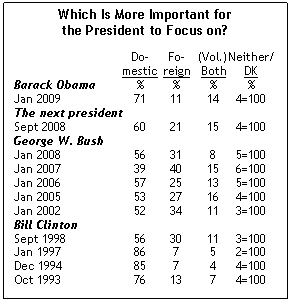 over the past decade, and the recent upward trend has been steep. The share of Americans saying that strengthening the nation’s economy should be a top priority has risen from 68% two years ago to 75% last January to 85% today. Concern about jobs has risen even more sharply. The 82% who rate improving the job situation as a top priority represents a 21-point jump from 61% a year ago.
Of the 20 issues people were asked to rate in both January 2008 and January 2009, five have slipped significantly in importance as attention to the economy has surged. Protecting the environment fell the most precipitously – just 41% rate this as a top priority today, down from 56% a year ago. The percentage rating illegal immigration as a top priority has fallen from 51% to 41% over the past year, and reducing crime has fallen by a similar amount (from 54% to 46%). And while reducing health care costs remains a top priority to 59% of Americans, this is down 10-points from 69% one year ago.
The public’s interest in many other policy areas remains relatively stable, by comparison. Roughly three-quarters (76%) say that defending the country from future terrorist attacks should be a top priority, making it the third highest priority among the 20 issues tested in the survey. As recently as two years ago, terrorism ranked at the top of the list of policy priorities. The share of Americans who rate terrorism as a top priority has not changed substantially in recent years; the issue has simply been leapfrogged by the economy and jobs at the top of the list.
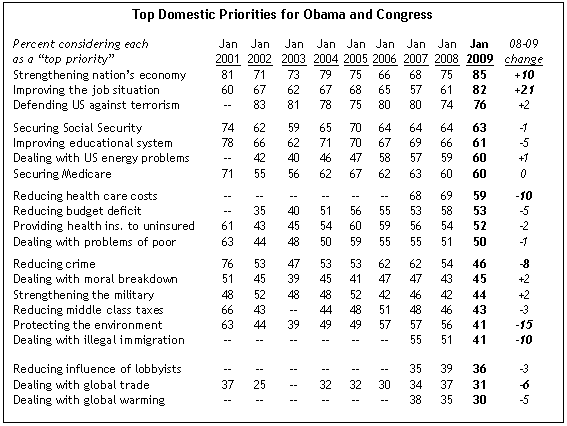
As with terrorism, public views of the importance of several other policy priorities have not changed much in recent years. Roughly six-in-ten continue to rate making the Social Security system (63%) and making the Medicare system (60%) more financially sound as top priorities. Dealing with the nation’s energy problems also remains a top priority for six-in-ten, as does improving the educational system (61%), though the public’s emphasis on the latter has slipped slightly in recent years.
Republicans’ Job Concerns Surge
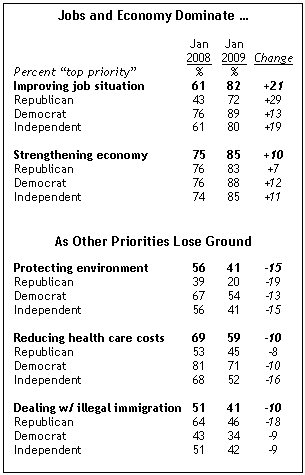 There is partisan agreement that strengthening the economy should be a top priority for the president and Congress in 2009 – more than eight-in-ten Democrats (88%), independents (85%) and Republicans (83%) rate strengthening the nation’s economy as a top priority.
There is also increasing agreement across party lines about the importance of improving the job situation. A year ago, 76% of Democrats rated improving the job situation as a top priority compared with just 43% of Republicans – among the biggest partisan divisions in 2008. Today, the partisan gap is much smaller; the share of Republicans rating jobs as a top priority has jumped 29 points to 72%. The percentage of Democrats citing jobs as a major priority has increased by a smaller margin (from 76% to 89%).
The large decline in the percentage of Americans citing the environment is seen across the political spectrum, but Republicans (20%) remain far less likely than Democrats (54%) or independents (41%) to say that protecting the environment should be a top priority for the president and Congress. The only policy that ranks lower than protecting the environment among Republicans is dealing with global warming (16%).
Far fewer Republicans rate dealing with illegal immigration as a major policy priority than did so in January 2008 (46% now, 64% then). Dealing with illegal immigration also has declined as a policy priority for independents and Democrats (nine points each).
Reducing health care costs is viewed as a less important priority than at the beginning of last year. Only about half of independents (52%) say that reducing health care costs should be a top priority, down from 68% a year ago. This decline is less pronounced among Democrats (down 10 points since 2008) and Republicans (down eight points).
Environment a Lower Priority
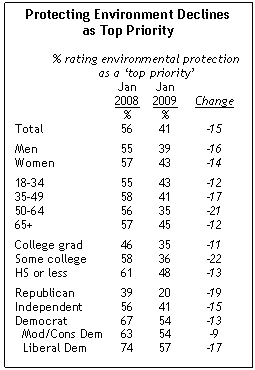 The 15-point decline in the percentage calling environmental protection a top priority this year is steep, but not unprecedented given the broader shift in public priorities. Between January 2001 and January 2002, the proportion rating environmental protection as a top priority fell by a similar amount (from 63% to 44%); a number of domestic priorities declined in importance following the Sept. 11 terrorist attacks. By January 2003, just 39% called environmental protection a top priority – comparable to today’s 41% – before resurging as a priority from 2006 to 2008, only to fall again this year.
The decline in the percentage calling environmental protection a top priority crosses partisan and demographic lines. For instance, only about four-in-ten women (43%) and men (39%) now say that protecting the environment should be a top priority; last January, 57% of women and 55% of men rated environmental protection as a top priority.
Deficits and Tax Cuts
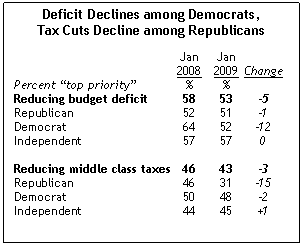 For the past several years, a greater percentage of Democrats than Republicans have rated reducing the budget deficit as a top priority. But this gap has disappeared, as a narrower majority of Democrats view this as a major priority than did so last year (64% vs. 52%). Republicans’ views about the importance of reducing the deficit have been stable (52% in 2008, 51% now).
By contrast, a partisan gap has emerged this year over reducing middle-class taxes. At the start of 2008, roughly half of both Democrats (50%) and Republicans (46%) rated this as a top priority. Today, just 31% of Republicans say middle class tax cuts are a top priority, compared with 48% of Democrats.
Crime Concerns Fall
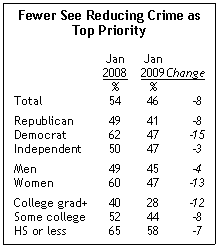 The public’s crime concerns have fluctuated over the past eight years. In January 2001, fully 76% rated reducing crime as a top priority. Reducing crime fell as a major goal after 9/11, but increased in 2006 and 2007 (62% rating it a top priority in each year). Currently, just 46% say that reducing crime should be a top priority, down from 54% in January 2008.
In the past year, the percentage of Democrats who view reducing crime as a major goal has fallen sharply – from 62% to 47%. Far fewer women and college graduates also rate crime reduction as a top priority (down 13 points and 12 points, respectively).
Dueling Agendas
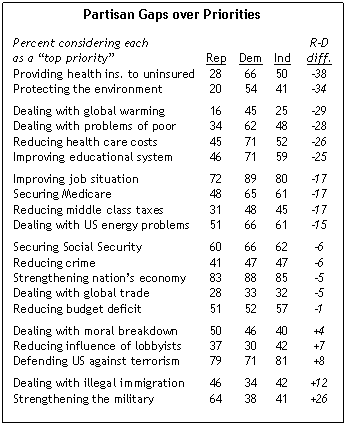 The fundamental gaps between Democratic and Republican priorities seen in previous years remain largely the same today. Democrats place a far higher priority on issues related to the poor, on the environment and on education than do Republicans. And Republicans place a higher priority on defense and illegal immigration than do Democrats.
As was the case a year ago, the single biggest partisan gap comes over how much priority to place on providing health insurance to the uninsured. Two-thirds (66%) of Democrats rate this as a top priority while just 28% of Republicans agree. Similarly, 62% of Democrats say that dealing with the problems of the poor and needy is a top priority, compared with 34% of Republicans. By contrast, Republicans place greater priority on strengthening the military (64% vs. 38% of Democrats) and dealing with illegal immigration (46% vs. 34%).
Most Want Obama to Focus Domestically
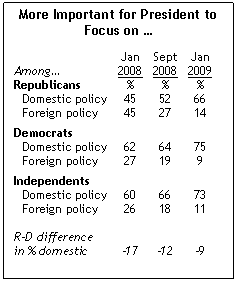 Democrats, independents and Republicans generally agree that it is more important for President Obama to focus on domestic policy than foreign policy. The partisan gap has narrowed since January 2008, when Republicans were evenly split about whether former President Bush should focus domestically or internationally (45% each). Currently, 66% of Republicans say it is more important for Obama to focus on domestic issues while just 14% say he should focus on foreign policy.
A year ago, majorities of Democrats (62%) and independents (60%) said that Bush should focus more on domestic than foreign policy. Even higher percentages of those groups express that view about Obama’s priorities today (75% of Democrats, 73% of independents).
Results for this survey are based on telephone interviews conducted under the direction of Princeton Survey Research Associates among a nationwide sample of 1,503 adults, 18 years of age or older, from January 7-11, 2009 (1,128 respondents were interviewed on a landline telephone, and 375 were interviewed on a cell phone, including 112 who had no landline telephone). Both the landline and cell phone samples were provided by Survey Sampling International.
The combined landline and cell phone sample are weighted using an iterative technique that matches gender, age, education, race/ethnicity, region, and population density to parameters from the March 2007 Census Bureau's Current Population Survey. The sample is also weighted to match current patterns of telephone status and relative usage of landline and cell phones (for those with both), based on extrapolations from the 2007 National Health Interview Survey. The weighting procedure also accounts for the fact that respondents with both landline and cell phones have a greater probability of being included in the sample.
The following table shows the error attributable to sampling that would be expected at the 95% level of confidence for different groups in the survey:
|
Group |
Sample Size |
Plus or minus… |
|
Total sample |
1,503 |
3.0 percentage points |
|
Form 1 sample |
769 |
4.0 percentage points |
|
Form 2 sample |
734 |
4.0 percentage points |
In addition to sampling error, one should bear in mind that question wording and practical difficulties in conducting surveys can introduce error or bias into the findings of opinion polls.
ABOUT THE CENTER
The Pew Research Center for the People & the Press is an independent opinion research group that studies attitudes toward the press, politics and public policy issues. We are sponsored by The Pew Charitable Trusts and are one of seven projects that make up the Pew Research Center, a nonpartisan "fact tank" that provides information on the issues, attitudes and trends shaping America and the world.
The Center's purpose is to serve as a forum for ideas on the media and public policy through public opinion research. In this role it serves as an important information resource for political leaders, journalists, scholars, and public interest organizations. All of our current survey results are made available free of charge.
All of the Center’s research and reports are collaborative products based on the input and analysis of the entire Center staff consisting of:
Andrew Kohut, Director
Scott Keeter, Director of Survey Research
Carroll Doherty and Michael Dimock, Associate Directors
Michael Remez, Senior Writer
Juliana Menasce Horowitz, Robert Suls, Shawn Neidorf, Leah Christian, Jocelyn Kiley and Neha Sahgal,
Research Associates
Kathleen Holzwart and Alec Tyson, Research Analysts