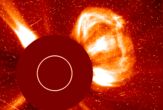
"I think the last week will go into the history books as one of the most dramatic periods of solar activity we have seen in modern time," Brekke told SPACE.com.
None of the latest eruptions was aimed directly at Earth, but glancing blows are expected.
By the numbers
The flares this week began with an X8 event at 12:25 p.m. ET Sunday. On this scale, all X-storms are severe, and the number indicates the degree of severity. An X3 flare erupted at 8:30 p.m. Sunday.
The first four flares in this long, amazing series date back to Oct. 22 and were ranked less than X2.
All flares of this magnitude are capable of disrupting communications systems and power grids and harming satellites. Two Japanese satellite failures and a power outage in Sweden were blamed on the first six storms.
The new flares were accompanied by coronal mass ejections of charged particles that take anywhere from 18 hours to two or three days to reach Earth. These CMEs represent the brunt of the storm unleashed by a flare.
A storm's precise strength, however, cannot be known until about 30 minutes before it strikes and depends on the orientation of its magnetic field. If that field is southward -- opposite the direction of Earth's north-pointing magnetic field -- then the potential is greatest for accelerating the local particles that can then damage satellites and fuel aurora.
More aurora
Scientists said the eruptions will generate increased auroras, the colorful Northern and Southern Lights excited by fast-moving particles, beginning midday Monday and into Tuesday and beyond. The lights shine because particles excite gas molecules in the atmosphere.
The chance of severe geomagnetic storming -- the root of auroras -- at middle latitudes is 30 percent Monday and 50 percent Tuesday, according to NOAA's Space Environment Center. The precise extent of the aurora at any moment can't be predicted, but it can be seen in real time with SPACE.com's Aurora Cam.
The fist flare Sunday was generated by Sunspot 486, which was the site of last week's major storms. The one late Sunday came from Sunspot 488, which is huge but has not been a major player until now. Monday's flare also leapt from Sunspot 488.
Both sunspots are about to rotate off the right side of the Sun's face, so their associated CMEs were not aimed squarely at Earth. However, these clouds of hot gas expand as they race into space at up to 5 million mph, so at least some effect at Earth is predicted.
Sunspots are dark, cooler regions of the solar surface. They are areas of pent-up magnetic activity, caps on upwelling matter and energy that can blow at any moment.
No scientist can recall nine X-class flares ever occurring in a 12-day period. More major flares are possible this week, forecasters said.