|
| Taxpayer 'guilty until proven innocent'? - Tuesday, June 03, 2003 at 13:01 | ||
| A case that began as a dispute over one man's tax liability is growing into a legal challenge to a tax-enforcement system that purportedly presumes the accused guilty until proven innocent.
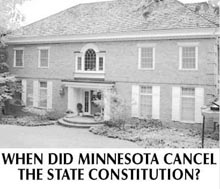
On April 30, a squad of Minnesota Department of Revenue vehicles pulled up to Robert and Rebecca Beale's 30-room, $3 million house in the Twin Cities suburb of North Oaks. Along with the house itself, the state workers seized personal items, including family heirlooms, two cars, an ATV, silverware, silver plates, guns, a coin collection and $5,000 in cash.
But Beale insists he owes no taxes because he no longer was a resident of Minnesota in 1998 when he sold his interest in a local television station. However, the state maintains Beale, now living in Naples, Fla., did not respond in time to its questions and owes nearly $800,000 in capital gains taxes, penalties and interest. Beale was at a business meeting in Philadelphia when he learned from his son the seizure was underway. "It almost makes you want to throw up, to think that someone is rifling through your stuff and trying to figure out what to take," said Beale, who notes his wife has vowed never to set foot in Minnesota again. The Minnesota Department of Revenue, or MDR, contends Beale could have appealed his case in tax court. But Beale argues he provided the MDR with all the documentation it needed to determine his 1998 residency. Going to tax court would only exacerbate his situation, he believes, asserting it's not a court at all but a branch of the executive with a serious conflict of interest. Beale cites Minnesota Statute 271.01, which authorizes the tax court "as an independent agency of the executive branch of government." That conflicts with the Minnesota Constitution, he says, which forbids the legislative, judicial or executive branches from exercising "powers properly belonging to either of the others." "Going into tax court is like joining the army; once you go in, you can't get out," Beale told WND. "They were trying to lure me in there, and I wasn't falling for it." On April 30, 2002, Beale notified the MDR, "If you want to make a claim against me, you will have to prove it by judicial due process of law in a judicial court." He got no response to the request, but has filed for a temporary injunction in district court to prevent his property from being sold. Beale also is representing himself in a civil complaint against MDR Commissioner Dennis Erno. "My position has been from the beginning that if they want to make a claim, they are going to have to prove it," Beale said. "I am not going to take their claim and then defend myself." Lynn Willenbring, a spokeswoman for the department, contended the tax court is fair. "Speaking from experience, the department wishes the tax court would work on our behalf all the time, but we frequently lose cases," she said. Willenbring, who since the interview has left the MDR to work for another agency, said the only way to take such a case to district court is to pay the tax liability and then sue for a refund. The MDR also contends the state Supreme Court affirmed the authority of the tax court in 1980. But Beale argues the decision refers only to establishment of the tax court. He believes a 2002 Minnesota law expanding the tax court's jurisdiction demonstrates its unconstitutionality, arguing it infringes on the jurisdiction of district court. When asked whether the dispute was over residency, Willenbring said she "would not be at liberty to say" unless Beale provided her with power-of-attorney to disclose the information. However, when the MDR seized Beale's house, it invited a local television station to film the event. KARE-TV reporter Rick Kupchella said he was informed, on the scene, the case was not a dispute over Beale's 1998 residency but concerned an audit dating back to 1994, covering years Beale's residency was not in dispute. But MDR spokeswoman Becky Christiansen told WND, "Residency was the issue in this case." "Information concerning the number of days spent in Minnesota was requested on a number of occasions and not provided, and the appeal was rejected, and a notice was issued," she said. Residency formula In 1998, as CEO of a high-tech company he founded, Comtrol Corp. in Maple Grove, Minn., Beale frequently returned to Minnesota but says he provided documentation proving he was a resident of Florida and not present in Minnesota more than half the year, in keeping with the law. Christensen said the formula for assessing residency is "complex," with "26 or 27 stipulations." However, according to the law, residency has two basic components. Minnesota residents include anyone domiciled in the state and anyone domiciled outside the state who spent more than 182 days in Minnesota. Beale contends his documentation proves he spent 172 days in Minnesota in 1998. He charges MDR appeals officer Charles Colombo with evading his responses to questions in order to push his case into tax court. The MDR argues Colombo sent two letters to Beale's attorney – dated Sept. 11, 2001, and Nov. 9, 2001 – asking for information to account for a discrepancy in Beale's documentation of his whereabouts in 1998.
The period in question – Dec. 6-20, 1998 – is critical, because if Beale was in Minnesota during that time, he would exceed the 182-day limit. But Beale says neither he nor his lawyer received those letters from Colombo. Christensen said Colombo's secretary insists she mailed them, but they were not sent by certified post. Colombo wrote Beale Dec. 19, 2001, saying the requests for information "were not sent to you," but to "your accountant," referring to his lawyer. Beale says this contradicts a Dec. 3, 2001, letter he received from Colombo, which said "enclosed are copies of the [Sept. 11 and Nov. 9] letters I sent to you and your clients." When Colombo sent copies of the letters to Beale on Dec. 3, 2001, Beale immediately responded with a clarification, explaining that a purported flight from Minneapolis/St. Paul to Ft. Myers, Fla., on December 20 actually was a flight from Ft. Meyers to Minneapolis/St. Paul on Dec. 21. That would indicate he was in Florida during the Dec. 6-20, 1998, period. Beale provided Colombo with contact information for Northwest Airlines to back up the documentation provided in his travel logbook, which the MDR has had for more than two years. However, Colombo rejected Beale's appeal without addressing the residency issue, bringing up a federal issue, which Beale insists is irrelevant. At that point, tax court was offered to Beale as his only option. "Mr. Beale chose not to go to tax court, apparently because he does not believe in it," said state tax director Jerry McClure, according to the St. Paul Pioneer Press. "He's deciding the law is unconstitutional or whatever. We have to follow the law." On Dec. 14, 2002, Beale received a "Demand for Payment and Intent to Levy Wages" notice stating, "If we do not receive your payment by Jan. 13, 2003, we will take collection action without further notice." The letter further stated, "By law, we may" take a number of actions, including "seize your property." Beale said he received notice of a tax lien on his house March 18 but had no warning of a seizure. "It sounds like something from a third-world country," he said. "They did it with no due process whatsoever and a TV station filming." In his civil complaint, Beale argues Minnesota cannot seize his property without due process in a court of law. Revenue shortfall On a website set up by his family called "Corrupt MDR,", Beale contends his constitutional and legal rights are "being systematically trampled in order to fund a state government that has found itself facing a serious revenue shortfall." The Twin Cities' KARE-TV reported the state is pumping new money into the revenue department to go after people who don't pay their taxes. When the MDR asked for more investigators in 2000, it promised the state it would increase collections by $60 million over two years, the station said. But Beale says he's no tax cheat, noting he faithfully paid an estimated $21.5 million in Minnesota employee payroll, corporate income, personal income, property and sales taxes while a resident of the state from 1972-1997. He moved to Florida in November 1997, he said, then sold his interest in KLGT-TV in the middle of 1998. Beale, an MIT grad and a founder of the Minnesota Christian Coalition, said it is standard practice to establish residency in Florida before selling a business, noting hundreds of former Minnesotans live in Naples. Earlier this month, he paid for an ad in the St. Paul Pioneer Press, titled "When did Minnesota Cancel the State Constitution?", which included a letter to Minnesota Gov. Tim Pawlenty arguing for his constitutional right to a judicial trial. In the letter, Beale contended his constitutional rights were being violating, citing Section 4 of the Minnesota state Constitution, which says, "The right of trial by jury shall remain inviolate, and shall extend to all cases at law without regard to the amount in controversy." He also appealed to Section 7, which declares, "No person shall be deprived of life, liberty and property without due process of law," and Section 18, which states, "The right of people to be secure in their persons, houses, papers and effects against unreasonable searches and seizures shall not be violated." Beale wrote to Pawlenty, "If citizens like you and me are unwilling to stand against the unlawful exercise of government power, this nation will have lost its commitment to the rule of law, not men."
|